
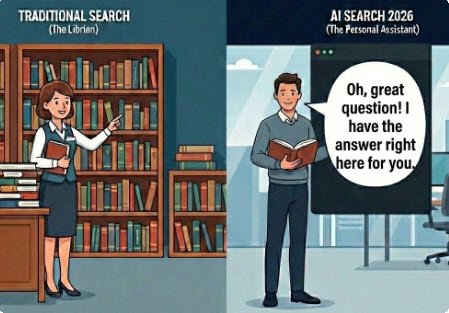
 For twenty years, search was a trip to the local library.
Google acted as the Librarian—a highly efficient gatekeeper who, when asked a question, would point you toward a shelf of ten books and leave you to find the answer yourself.
Success for a brand was simple: have the brightest cover on the shelf so the librarian would pick you.
But in 2026, the library has been replaced by the Personal Assistant.
When a teacher asks their AI assistant, “How do I explain fractions to a struggling 5th grader?” the assistant doesn’t hand over a list of websites. It has already “read” the internet. It leans in and gives the answer directly: “Research shows that students often fail because fractions are too abstract; the most effective fix is ‘offloading’ that mental stress onto a visual number line, which lets them physically see the distance between numbers rather than just memorizing rules.”
The Citation Arbitrage: Winning the “Zero-Click” War
We are witnessing a “Tipping Point” in human behavior. In 2026, over 80% of searches now end without a single click. The assistant provides the answer, and the user moves on. While raw traffic is “tanking,” the value of an AI citation is skyrocketing.
- The High-Intent Visitor: A user who does click through from an AI summary is 4.4x more valuable than a traditional searcher. They aren’t “browsing”; they have already been “pre-sold” by the AI’s recommendation.
- The Trust Factor: AI models are like “parrots”—they repeat what they can clearly understand and verify. If your content lacks the “Doctor’s Coat”—the structured data and credentials that signal authority—the parrot will simply ignore you and quote your competitor.
The Architecture of Truth: 3 Pillars of Answer Engine Optimization (AEO)
If the Personal Assistant is the new gatekeeper, our job is to become its most trusted advisor. This requires a shift from “Content Creation” to “Information Architecture”:
- Structure for Scanners: Use clear, question-based H2 headlines and bulleted lists. If a human can’t skim your page in three seconds, an AI can’t summarize it in a millisecond.
- Own the Entity, Not the Keyword: AI doesn’t look for words; it looks for “Knowledge Networks.” Don’t just mention a topic—prove you own the depth around it.
- Feed the Machine: Use explicit Schema markup to act as a “nutrition label” for your content, telling the AI exactly what it’s looking at.
The goal of modern Answer Engine Optimization (AEO) isn’t just to be “found.” It’s to be the Response. In the age of the Personal Assistant, if you aren’t the answer, you don’t exist.
References & Data Sources:
- Gartner: Traditional Search Volume Decline and the Rise of Generative AI (2026)
- Bain & Company: Consumer Reliance on AI Search Results (2025/2026)
- Ahrefs/Semrush Research: The Economic Value of AI-Referred High-Intent Traffic

As Founder of The SEO System, Richard delivers strategic consulting and builds high-performing teams that drive measurable growth, search authority, and long-term search equity.
Richard is currently accepting select clients for SEO and AEO consulting. Learn more at https://richardcummings.info/consulting.html
- The AI Inconsistency Gap: Why Your Brand is Winning on Google but Losing the “Answer War” - February 26, 2026
- The Personal Assistant Pivot: Optimizing for AI Search and AEO in 2026 - February 26, 2026
- The Ultimate Guide to Dental SEO: How to Rank Higher & Attract More Patients - March 10, 2025